
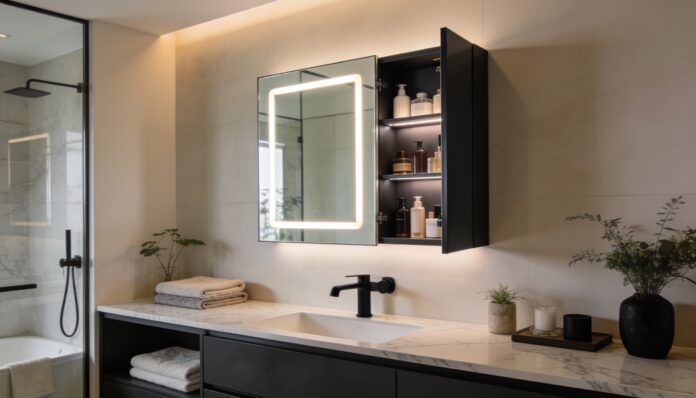


The answer to this question is complicated since there’s no ranking to establish. This is because LED mirrors and backlit bathroom mirrors describe different products with different purposes. Choosing between them requires knowing which purpose the bathroom needs to serve.
The terminology around lighted mirrors has never been standardized. “LED mirror”, “backlit mirror”, “illuminated mirror”, “Hollywood mirror”, and “halo mirror” all appear in product listings for fixtures that differ significantly in how they work. The distinction that matters, specifically where the LEDs sit relative to the mirror glass, determines whether the fixture primarily contributes atmosphere or accuracy. These are genuinely different functions.
A backlit bathroom mirror uses a specific LED position: the strips sit on the back face of the mirror panel, pointing away from the user and toward the wall. The light they emit does not reach the face directly. It bounces off the wall surface and returns as a diffuse ambient glow around the perimeter of the mirror, which creates the halo effect visible in most high-end hotel bathrooms and spa facilities. It is architectural, atmospheric, and distinctly different from what front-lit LED strips produce.
The distinction matters because the two types of lighted mirrors solve different problems. If the primary problem is grooming accuracy, meaning seeing the face clearly, without shadow, and with color rendering sufficient for decisions that must hold under natural light, then front-lit LEDs at face height are the correct specification. They direct light toward the subject.
If the primary problem is atmosphere, meaning a designed bathroom that photographs well and creates a spa impression, then a backlit bathroom mirror is the correct specification. It directs light toward the wall, creating the layered glow effect that changes how the room reads visually rather than how accurately the face is lit.
Most bathrooms need both at different times. The 6:30 a.m. grooming session requires functional task lighting. The 9:30 p.m. bath benefits from atmospheric ambient light. Understanding which product delivers which result and which can be combined in a single fixture resolves the comparison question. The answer is not that one type is better; it is that they serve different modes of bathroom use, and specifying correctly requires identifying which mode is primary.
The Terminology Problem: Why “LED Mirror” Says Very Little
The confusion between LED mirror and backlit mirror exists because both descriptions are technically accurate for the same product category while describing meaningfully different subtypes. Every lighted mirror uses LEDs, as they are the dominant lighting technology for this application. But LED mirror has become the generic term that appears across all subtypes, which means it communicates nothing specific about where the LEDs sit or what effect they produce.
The position of the LEDs is the only variable that matters for determining the functional result. LEDs positioned at the edges of the mirror face, pointing at the user, produce direct illumination. LEDs positioned on the back face of the mirror, pointing at the wall, produce indirect ambient light. LEDs positioned on both faces with separate controls produce both effects on demand. Hollywood mirror refers to a specific front-lit configuration with bulbs at regular intervals around the perimeter, replicating the makeup studio dressing room. Halo mirror is more precisely descriptive of the backlit configuration.
The practical implication is that reading product descriptions for lighted mirrors requires active scrutiny. The presence of the word LED tells you nothing about light direction. The presence of the word backlit or a visible glow behind the glass in product photography confirms a back-LED configuration. Spec sheets that list a single luminous output without specifying direction almost always describe front-lit models, since backlit output depends on the wall bounce rather than direct lumens at the face.
How Backlighting Works and What It Actually Produces
In a backlit configuration, manufacturers attach LED strips to the back face of the mirror glass, typically running along the perimeter. These strips face the wall rather than the user. When illuminated, the light output travels from the LEDs to the wall directly behind the mirror and diffuses outward, creating a visible glow around the perimeter of the mirror face. The quality of this effect depends on three variables: the distance the mirror stands from the wall, the reflectivity and color of the wall surface, and the color temperature and intensity of the LED strips.
A mirror mounted flush to the wall with no standoff gap produces no halo effect because the LEDs require wall clearance to diffuse properly. Frameless models with a deliberate wall standoff built into the mounting hardware produce the most consistent and visually refined result. For a backlit bathroom mirror to perform as intended, this standoff distance is as important as the LED specification itself. Most quality models engineer this into the mounting system rather than leaving it to the installer.
The light output reaching the user’s face from a backlit configuration is indirect and diffuse, meaning it has traveled from the LED source to the wall and returned as ambient illumination rather than direct task lighting. This produces a softer, more even ambient brightness in the room, often raising the perceived luminance of the entire wall surface. It does not provide the face-level shadow elimination that direct front-lit illumination achieves, but that is not its purpose. Backlighting serves as an atmospheric technology, not a precision grooming technology.
Front-Lit LED Mirrors: The Task Lighting Case
Front-lit configurations position the LEDs at the edges or across the face of the mirror glass, pointing directly toward the user. The light arrives at the face without redirection, producing specific effects: elimination of the single-source shadow created by overhead lighting, even coverage across both sides of the face simultaneously, and the ability to specify CRI at the point of use rather than after diffusion through ambient room air.
Shadow elimination is the most practical benefit. A single overhead light creates the same shadow geometry in every bathroom, specifically dark under the eyes, nose, and chin, because light from above behaves the same way everywhere. Front-lit LED strips at mirror height create light from multiple directions simultaneously, reproducing the multi-directional quality of diffuse natural light. Professional makeup studios, barbershops, and theatrical dressing rooms use this configuration because it makes face-level assessment reliable across different external lighting environments.
CRI specification applies at the face with front-lit models in a way it does not with backlit. A CRI 90+ front-lit strip delivers CRI 90+ at the subject because the light travels directly from the source to the face. A backlit strip delivers whatever CRI remains after the light bounces off the wall and diffuses, which is typically lower and less consistent. For color-sensitive grooming tasks, this difference is meaningful. For ambient room lighting, it is not.
Which Type Works for Which Bathroom
The specification decision is cleaner than the product options make it appear. A primary bathroom used as a daily grooming station, where makeup application, detailed shaving, skincare treatment, or any color- and texture-sensitive work happens regularly, benefits most from front-lit illumination at CRI 90+, dimmable to a lower ambient level for non-task use. The precision is the feature; the atmosphere is secondary.
A bathroom where atmosphere carries equal or greater weight than precision, such as a powder room that exists primarily to impress guests, a spa-style primary bath used predominantly for soaking rather than detailed grooming, or any guest bathroom where the visual impression matters more than the grooming functionality, benefits more from backlighting. A backlit bathroom mirror changes the room in a way that frontal illumination does not: it turns the mirror into a light source, makes the wall glow, and produces the layered quality that separates a designed bathroom from an assembled one.
Allsumhome’s back-lighting range includes frameless and thin-frame mirror models with built-in dimming, adjustable color temperature from 3000K to 6000K, and wall standoff mounting hardware designed to maximize the halo effect against the wall surface. These are configurations suited to bathrooms where visual atmosphere is a primary design priority alongside the functional requirements of daily use.
Hybrid Models: When Both Are Required
Hybrid models combine front-lit and backlit LED configurations in a single fixture, with independent circuit control so each mode operates separately. When both modes are active simultaneously, the result is layered illumination: direct frontal light for task accuracy in the foreground, diffuse backlit ambient glow against the wall in the background. Each mode can be dimmed independently, producing a wide range of lighting conditions without changing fixtures.
The use case for a hybrid model is the primary bathroom that functions as both a grooming station and a relaxing environment at different times of day. Morning grooming runs on full front-lit brightness. Evening bathing enjoys warm, backlit ambience. The same mirror, the same wall position, two meaningfully different lighting experiences on demand.
The specification to confirm before purchasing a hybrid model is whether the front and back circuits are independently controllable or share a single switch. Independent control is the feature that makes the hybrid format genuinely versatile; a shared switch simply illuminates both simultaneously and provides no mode flexibility. This distinction is worth confirming in the product spec before purchase, not after installation.
A backlit bathroom mirror is not a lesser version of a front-lit LED mirror; it is a different product designed for a different primary purpose. The halo effect it creates changes the atmosphere of the room in a way that front-lit illumination does not. The precision that front-lit LEDs provide for face-level grooming assessment is something backlighting cannot replicate.
The decision is simple once the use case is established. If accurate face-level lighting is the primary requirement, specify front-lit at CRI 90+. If architectural atmosphere is the primary requirement, specify a backlit configuration. If both are required at different times, specify a hybrid model with independent controls. The product exists for each purpose. The specification just needs to match the intent.