
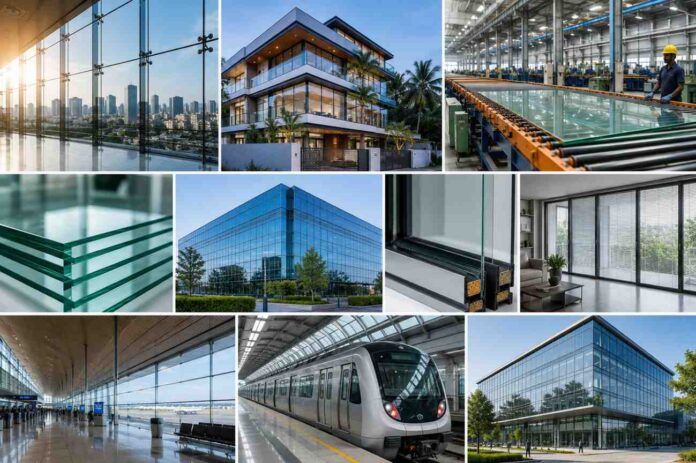


India’s construction industry is undergoing one of the most significant quality revolutions in its history — driven by tightening building codes, rising occupant safety expectations, and a growing understanding that the materials specified today will determine building performance for the next 30 to 40 years. At the centre of this shift is the glass industry. The country’s leading toughened glass manufacturers are no longer simply heat-treating float glass and shipping panels to site. They are operating certified production facilities, investing in automated quality control systems, and providing the technical documentation that modern construction procurement demands. Alongside toughened glass, correctly specified laminated safety glass is transforming how India’s buildings handle the most safety-critical glazing locations — overhead applications, structural balustrades, and high-consequence facade elements where post-breakage integrity is not optional. This article examines what India’s best glass manufacturers are doing differently, why it matters for every construction project, and how to evaluate a manufacturer’s quality claims beyond the surface level.
The Manufacturing Revolution in Indian Safety Glass
A generation ago, the Indian toughened glass market was dominated by small regional processors operating older manually controlled furnaces with limited quality oversight. Products varied widely between batches, documentation was sparse, and the concept of IS certification as a procurement requirement was not universally understood or enforced.
That picture has changed substantially. India’s leading manufacturers today operate continuous tempering furnaces with real-time temperature monitoring across the full glass ribbon width, computerised quenching control systems that maintain consistent cooling rates from panel to panel, and automated glass handling that eliminates the edge damage from manual contact that was a common cause of premature panel failure in earlier production methods.
The investment behind this transformation is significant — a modern, fully automated toughened glass production line represents a capital commitment measured in tens of crores, and the manufacturers who have made that investment are operating at a quality level that creates a genuine gap between their products and those of lower-investment competitors.
For project teams evaluating glass suppliers, understanding what that investment looks like in practice — and what questions to ask to confirm that the claimed investment is real — is the foundation of intelligent procurement.
IS Certification: The Quality Baseline That Every Supplier Must Meet
The Bureau of Indian Standards certification under IS 2553 (Part 1) for safety glass and IS 14900 for float glass is the minimum quality baseline for any glass supplier on a serious Indian construction project. IS certification requires a manufacturer to demonstrate consistent production to the standard through factory audits, product testing, and ongoing production surveillance — and to maintain that demonstration through a continuous quality management process.
Obtaining IS certification is not trivial — the factory audit process is thorough, the product testing requirements are specific, and the surveillance commitment is ongoing. A manufacturer holding current, active IS licences across all relevant standards has demonstrated a quality management commitment that uncertified competitors have not.
Verification is straightforward: request the IS licence number from the supplier, confirm the specific standards covered, and verify licence status on the BIS public portal. An active licence confirms current compliance; a lapsed or absent licence is a disqualifying finding for any project where glazing safety compliance is a requirement.
Beyond IS certification, the most quality-conscious manufacturers also hold ISO 9001 quality management system certification — an international standard that demonstrates systematic process control beyond the product-specific requirements of IS standards.
The Technical Case for Laminated Safety Glass in High-Consequence Locations
Toughened glass is the correct safety glass specification for the majority of building glass applications — doors, partitions, balustrades in standard residential settings, facade infill panels. But in a defined set of high-consequence locations, toughened glass alone is insufficient regardless of its quality, thickness, or manufacturer certification.
The reason is physical, not regulatory: toughened glass breaks completely when its structural limit is reached. Every fragment separates from its neighbours and scatters. In vertical applications at ground level this is manageable — the safety breakage pattern of small, blunt fragments minimises injury risk. In overhead applications or at significant height, the same fragment scatter creates a serious hazard — falling glass fragments onto occupied areas below are a real injury risk regardless of their individual size.
Laminated safety glass solves this by retaining every fragment in the PVB or SGP interlayer after breakage. The panel cracks — sometimes dramatically — but holds together, maintaining weather exclusion and preventing fragment fall until the panel is safely removed and replaced. This post-breakage integrity is the essential performance characteristic for skylight panels, glass roofs, atrium covers, canopies over pedestrian areas, structural glass floors, and balustrades at significant fall heights.
Under IS 6262 and the National Building Code of India, laminated glass is specifically required for these overhead and high-consequence applications. Substituting toughened glass for laminated glass in these locations is not simply a specification preference — it is a code non-compliance that creates legal liability for the building owner, developer, and contractor.
What Sets India’s Top Glass Manufacturers Apart From Generic Suppliers
Price is the most visible variable in glass procurement and the least reliable indicator of quality. The variables that actually determine whether a glass panel performs safely over its design life are largely invisible at the point of procurement and only become apparent in long-term performance data and quality documentation.
India’s leading glass manufacturers distinguish themselves in several ways that procurement teams should evaluate explicitly. First, production transparency — the willingness to allow factory visits and to share process documentation, calibration records, and quality control data. Manufacturers confident in their processes welcome this scrutiny; those whose quality management does not support scrutiny will find reasons to avoid it.
Second, technical support capability — the availability of application engineers who can review specifications, advise on glass type and thickness for specific structural conditions, check shop drawings for fabrication errors, and provide technical responses to design queries. This capability adds measurable value to complex projects and is entirely absent from commodity glass supply relationships.
Third, batch traceability — the ability to trace any panel delivered to site back to its specific production batch, the raw glass used, the furnace cycle parameters, and the test results for that batch. This traceability is essential for responding to quality issues identified after delivery and for the documentation required to demonstrate compliance in building certification processes.
Applications Driving Demand for Certified Safety Glass in India
The demand for certified toughened and laminated safety glass is growing across virtually every building sector in India. Infrastructure projects — metro stations, airport terminals, railway stations, and bus terminals — specify certified safety glass for passenger area glazing as a condition of project approval, with IS certification documentation required at the tender stage.
The commercial office sector — particularly the IT and ITES parks driving development in Hyderabad, Pune, Bengaluru, and Chennai — specifies certified glass for facade, partition, and balustrade applications where tenant fit-out standards and insurance requirements drive glass quality specifications.
Healthcare and educational facilities, where the duty of care to building occupants is particularly high, increasingly specify laminated safety glass in clinical zones, psychiatric facilities, and sports halls where the standard toughened glass specification is insufficient for the specific safety demands of those environments.
The luxury residential sector — villa developments in Goa and Kerala, high-rise premium apartments in Mumbai and Delhi NCR — specifies certified safety glass as part of a broader quality commitment to buyers who are increasingly design-literate and aware of the safety glass requirements that accompany the large glass areas they are purchasing.
Compliance Documentation: What Every Project Should Require
A compliant glass installation is only verifiably compliant if the documentation exists to prove it. The documentation package for a fully compliant glass project includes the IS licence certificate for every relevant standard, NABL-accredited laboratory test reports for the delivered batches, delivery notes matching batch numbers to delivered panels, shop drawing approval records, and installation acceptance documentation with photographic records.
Requiring this complete documentation package from every glass supplier as a contractual condition — not as an afterthought when a problem arises — is the procurement discipline that protects every project stakeholder. It is also the discipline that separates project teams who manage glass quality proactively from those who discover problems after installation when rectification is maximally expensive.
Frequently Asked Questions
What is the difference between toughened glass and laminated safety glass?
Toughened glass is heat-treated to be 4 to 5 times stronger than annealed glass and breaks into small blunt fragments. Laminated safety glass bonds two or more glass panes with a PVB or SGP interlayer that holds all fragments after breakage. For overhead applications, laminated glass is mandatory because fragment retention is essential when glass breaks above occupied areas.
How many toughened glass manufacturers in India hold current IS certification?
BIS maintains a public register of IS licence holders. The number of certified manufacturers varies as licences are granted, renewed, and lapsed. Verify any specific manufacturer’s current IS certification directly on the BIS portal using their licence number — do not rely on a supplier’s self-reported certification status without independent verification.
Is IS 2553 the only standard that applies to safety glass in Indian buildings?
IS 2553 Part 1 covers safety glass performance requirements. IS 6262 covers glass in buildings — design, selection, and installation guidance. IS 14900 covers float glass quality. The National Building Code references all three. A complete safety glass specification should confirm compliance with all applicable standards, not just IS 2553 in isolation.
Can laminated safety glass be used as a direct substitute for toughened glass?
In most applications, laminated toughened glass — using fully tempered glass panes as substrates — can substitute for toughened glass while providing additional post-breakage integrity. In overhead applications, laminated glass is the mandatory specification regardless of preference. In other locations, the structural engineer should confirm whether laminated glass meets the specific load requirements of the installation.
What should I do if a glass supplier cannot provide IS certification?
An inability to provide current IS certification should be treated as a disqualifying finding for any project where safety glass compliance is required. The risk of using uncertified glass — in terms of product performance, regulatory compliance, insurance validity, and legal liability — is not manageable through contractual warranties from an uncertified supplier.
Conclusion
India’s safety glass manufacturing sector is in a period of genuine quality improvement — led by manufacturers who have invested in certified production processes, quality management systems, and technical support capabilities that set them apart from generic commodity suppliers. For project teams, the opportunity is to benefit from that improvement by procuring from the right suppliers and requiring the documentation that proves quality delivery.
The specification decisions made before a glass panel is fabricated — glass type, thickness, interlayer for laminated applications, IS certification requirement, heat soak specification for critical locations — determine whether a building’s glazing performs safely for its design life. Getting those decisions right costs nothing extra in time. Getting them wrong can cost everything.