
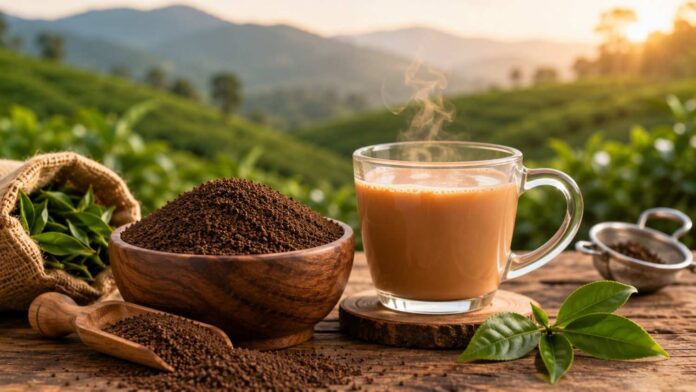


Somewhere between 5:30 and 6 in the morning, in kitchens across Kerala, a particular smell rises before anyone has fully woken. It is earthy, warm, slightly woody — the unmistakable opening note of a tin of quality tea powder meeting the humidity of the air. By the time the kettle comes to a rolling boil, the house already knows the day has begun. For generations of Malayali households, finding the best tea powder in kerala has not been a shopping question. It has been a matter of daily identity — as personal as the way a grandmother holds her tumbler, and as consequential as the first taste of the morning. This post goes deeper than the familiar tin: into the science of altitude, the history of the estates, the Ayurvedic wisdom behind the spiced brew, and the practical knowledge that helps you choose a powder genuinely worth opening.
Why Kerala Produces India’s Most Distinctive Tea Powder
Kerala’s tea superiority is not a marketing claim — it is a geographic fact. The Western Ghats, which rise sharply from the coastal plains through the districts of Idukki and Ernakulam, create a growing environment that concentrates every quality that matters in a tea leaf.
At Munnar’s core elevations — between 1,500 and 2,500 metres — the temperature rarely climbs above 20°C even in peak summer. This persistent coolness slows the metabolic rate of Camellia sinensis, the tea plant, dramatically. Where a plains-grown leaf completes its growth cycle in days, a high-altitude Munnar leaf takes weeks. That additional time is not idle — the plant uses it to accumulate.
What accumulates are the compounds that define great tea: theaflavins and thearubigins (responsible for body, colour, and antioxidant activity in black tea), catechins and EGCG (the primary health-active compounds in green tea), L-theanine (the amino acid that produces calm alertness rather than jittery stimulation), and the essential aromatic oils that give a quality tin its distinctive smell when you open the lid.
The result is a leaf that carries more of everything valuable — more flavour, more colour, more wellness benefit — than any equivalent grown at lower altitude. This is why Munnar-sourced tea powder brews darker at the same quantity, smells more alive from the tin, and produces a finish that lingers rather than dropping off immediately. It is not marketing. It is the chemistry of altitude.
What is the Best Tea Powder in Kerala? Understanding the Grades
The best tea powder in Kerala is not a single product — it is a category defined by origin, grade, and freshness working together. Understanding each dimension helps you choose with genuine confidence rather than brand familiarity.
Origin: The growing region is the foundation. Munnar, Vagamon, Peermedu, and the upper Idukki ranges all produce quality tea, but Munnar’s combination of altitude, rainfall pattern, and red laterite soil creates a distinctive character — bolder than Nilgiri, cleaner-finishing than Assam, more complex than most Darjeeling everyday grades.
Grade: Indian tea powder is graded by particle size. CTC (Crush, Tear, Curl) processing produces the dust and fannings formats that dominate household chai — fast-brewing, bold, milk-friendly. Within CTC dust, finer particles extract fastest and darkest; slightly coarser grades offer marginally more complexity. Broken leaf and whole leaf grades brew more slowly and produce a more nuanced, layered cup. The best everyday Kerala chai uses a quality CTC dust; the best weekend or contemplative cup uses broken or whole leaf.
Freshness: A packed-on date within the past three to four months is the most reliable quality signal that most consumers overlook. Tea powder degrades — not dramatically, but measurably — after processing. The aromatic volatile compounds that give a fresh tin its character begin escaping immediately upon exposure to air, light, and heat. A tin packed six months ago and a tin packed six weeks ago are not the same product, even from the same garden and the same batch.
The combination of Munnar origin, appropriate grade, and demonstrable freshness is the definition of the best tea powder in Kerala. When all three are present, the cup announces its quality before you have even brewed it.
How the Munnar Tea Tradition Shaped Kerala’s Chai Culture
The story of Munnar Tea begins in the 1860s, when British planters recognised the extraordinary potential of the high ranges. The combination of acidic red soil, misty cool temperatures, and the consistent rainfall pattern of the Western Ghats produced a leaf that was unlike anything grown on the plains of Assam or the lower slopes of Darjeeling.
By the early 20th century, Munnar had become one of Asia’s most productive and respected tea-growing regions. The estates developed their own communities — schools, hospitals, housing — built around the rhythm of the harvest. Workers, many of them women whose expertise in identifying the exact moment of readiness for each bud was irreplaceable, developed a generational knowledge that no machine has fully replicated.
This history matters for modern consumers because it explains the traceability that the best Munnar tea producers maintain. An estate that has been growing, processing, and blending tea for over a hundred years carries accumulated knowledge about which gardens, which seasons, and which processing choices produce the finest cups. That knowledge is present in every tin — not as sentiment, but as measurable quality.
Importantly, Kerala’s tea culture absorbed this history into daily domestic life in a way that no other Indian state quite replicated. The chaya kada — the roadside tea stall — became a social institution as much as a commercial one. The standard expected at a Kerala chaya kada is higher than most people realise: a cup that is deep amber without being murky, bold without being bitter, fragrant from the moment it is poured. Meeting that standard requires quality tea powder. It always has.
The Ayurvedic Case for Quality Kerala Tea
Ayurveda classifies black tea as a deepana substance — one that kindles the digestive fire (agni) and sharpens mental clarity. This is not merely traditional nomenclature: modern nutritional science finds the mechanism behind the same observation. L-theanine promotes calm, focused alertness by modulating alpha brain wave activity. Theaflavins support cardiovascular health and reduce oxidative stress. The warmth of a morning black tea activates digestive enzyme production.
The key qualifier in Ayurvedic tradition is always quality of source. A preparation is only as potent as the material it is made from. Low-grade, aged, multi-origin blended tea powder delivers a weaker version of every benefit — less L-theanine, lower theaflavin content, degraded aromatic compounds. High-altitude, freshly processed, estate-sourced Kerala tea delivers the full expression.
Seasonal Ayurvedic use adds another dimension. During Kerala’s monsoon months — the vata season of cold, movement, and instability — the prescription is warming, grounding, spiced preparations. A strong morning black tea with crushed ginger, bruised cardamom, and a single clove is Ayurveda’s monsoon recommendation expressed as a daily habit. The tea is not incidental to this preparation — it is its foundation. The quality of that foundation determines the quality of the entire cup’s therapeutic contribution.
What Separates Great Kerala Tea Powder From the Ordinary
The practical test for tea powder quality takes ten seconds and requires no equipment beyond the sense of smell. Open the tin. Breathe in before you brew.
Great Kerala tea powder smells alive. The aroma is warm, earthy, and slightly woody — sometimes with a faint floral or mineral note depending on the growing season and garden. It announces itself. This smell is the volatile oil content of fresh, high-altitude leaf expressing itself. It means the compounds you care about — for flavour and for wellness — are still intact.
Poor quality or stale tea powder smells of very little. Or it carries a faint mustiness — the smell of air having done its work on the volatile compounds over too many weeks or months of storage. No amount of careful brewing recovers what has already been lost at this stage. The cup will be flat, the colour thin, the finish absent.
Beyond aroma, watch the colour when brewing. Quality Munnar dust tea powder should show visible colour within 30 to 45 seconds of entering boiling water. The liquor should be a consistent copper-amber — clear rather than murky, vibrant rather than flat. If it takes two minutes to colour and still looks pale, the leaf was either too old or too low-grade to deliver.
Packaging honesty is the final signal. A brand willing to name its growing region, provide a packed-on date, and describe its sourcing specifically is a brand accountable for what is in the tin. Vague “premium blend” or “finest gardens” labels without specifics are not quality claims — they are the absence of them.
How to Brew Kerala Tea Powder for the Perfect Cup
The right method matters as much as the right tin. The best tea powder in Kerala produces its best cup when given the method it deserves.
Bring water to a full, rolling boil — not a simmer, not a gentle steam. Add tea powder to the boiling water first: one heaped teaspoon per 150ml is the baseline for a standard-strength cup, one and a half for the bold Kerala style. Allow 60 to 90 seconds for the colour to develop before reducing heat. Then add cold milk in a slow, standing pour — this cools the brew slightly and aerates it simultaneously, producing the characteristic smoothness of a well-made Kerala chai.
Simmer on the lowest flame for 60 more seconds. Strain directly into the cup — never let it continue steeping in the pot. Serve immediately.
For monsoon mornings: add one inch of crushed ginger to the cold water before heating, two bruised cardamom pods as the water comes to boil, and the tea powder last. Simmer for two minutes before the milk. The kitchen will smell exactly as it should.
The colour of a well-made Kerala tea powder cup should be a deep, clear amber — warm mahogany in good light. The aroma should rise immediately from the cup. The finish should linger for at least a minute after the last sip. If all three are present, you have chosen and brewed well.
Frequently Asked Questions
Q: What makes Kerala tea powder better than other Indian tea powders? A: Kerala tea powder from Munnar’s high-altitude estates is grown at 1,500–2,500 metres, where cooler temperatures slow leaf growth and concentrate theaflavins, L-theanine, and aromatic oils. This produces a bolder, cleaner, more complex cup than plains-grown equivalents from Assam or Nilgiri at the same brewing quantity.
Q: How do I identify the best tea powder in Kerala? A: Open the tin and smell before brewing. Fresh, high-quality Kerala tea powder has a warm, earthy, slightly woody aroma that announces itself immediately. Also check for a packed-on date within three to four months and origin transparency — a named growing region rather than a vague “premium blend” label.
Q: Is Munnar tea powder the same as Kerala tea powder? A: Munnar tea powder is the most celebrated category within Kerala tea powder. Munnar refers specifically to the high-altitude growing region in the Western Ghats. Not all Kerala tea comes from Munnar — but Munnar-sourced tea is widely regarded as the standard of excellence for the state’s tea identity.
Q: How much tea powder should I use per cup? A: One heaped teaspoon (approximately 2–2.5 grams) per 150ml of water is the standard for a medium-strength cup. For the bold Kerala style, use one and a half teaspoons. Adjust to preference — quality tea powder is forgiving across a range of quantities without turning bitter.
Q: Does the freshness of tea powder affect health benefits? A: Yes, significantly. Theaflavins, catechins, and L-theanine degrade after processing, particularly after exposure to air, heat, and moisture. A freshly packed, estate-sourced Munnar tea powder delivers meaningfully higher active compound concentrations than the same leaf stored for six or more months. Freshness and wellness return are directly linked.
Conclusion: The Tin That Carries the Morning
There is a particular quality of morning that depends entirely on the first cup being right. The colour rising in the pot, the steam carrying the right aroma, the warmth in the first sip that confirms the day has started properly — these are small things, repeated so often across a lifetime that they become the texture of daily life itself.
The best tea powder in Kerala is the ingredient that makes those mornings possible. Not the only ingredient — the water, the method, the time given to the brew all matter — but the one that sets the ceiling. A great brewing method cannot rescue a flat tin. A quality tin, brewed with even ordinary care, produces a cup that earns its moment.
For Kerala households, this has always been understood. The tin on the shelf is not a commodity purchase. It is a daily commitment — to the morning, to the people sharing it, and to the specific warmth that only a great cup of Munnar tea delivers. Choose the tin accordingly.