


This article is contributed by Mr.Ahmad Mydeen, an expert in architectural Facade and building elevations. He is the founder of Galaxy Graphics & LED (www.galaxygraphicsled.in), a leading firm specializing in premium ACP facades and structural glazing solutions across Tamil Nadu and South India.
South India’s commercial construction sector is undergoing a visible transformation as developers increasingly adopt modern facade systems designed for durability, branding, and energy performance. Cities such as Chennai, Bengaluru, Hyderabad, Coimbatore, Kochi, Madurai, and Trichy are witnessing increasing demand for modern commercial exteriors that combine aesthetics, durability, and long-term performance. Among the most preferred solutions today are ACP exterior systems and structural glass glazing systems.
Traditionally, many commercial buildings relied on painted plaster finishes and conventional elevation designs. While functional, these systems require frequent maintenance and struggle to deliver the modern visual appeal expected in today’s competitive business environment. As retail branding, corporate identity, and customer experience become more important, developers and business owners are increasingly investing in premium facade solutions.
Industry analysts continue to project steady growth in India’s commercial facade and architectural glass sector, driven by IT infrastructure, healthcare expansion, and premium retail development across major South Indian cities.
Why Building Exteriors Are Getting Serious Attention Now
A building’s exterior is no longer just about protection from weather. It directly represents the business operating inside. For commercial properties — offices, hospitals, showrooms, and retail spaces — the exterior system is the first thing a client or customer notices. In competitive markets like Chennai and Bengaluru, that first impression carries real weight.
This shift in thinking is pushing developers and business owners away from conventional plaster finishes toward modern cladding systems that offer cleaner lines, longer life, and stronger visual impact. Both ACP and structural glass address these needs effectively, which is why adoption across South India has grown steadily over the past several years.
ACP Commercial exteriors — A Practical Choice for Commercial Projects
ACP, or Aluminium Composite Panel, consists of two aluminium sheets bonded over a core material. The panels are lightweight, flat, and available in a wide range of colors and finishes. They are used extensively on showrooms, hospitals, educational institutions, textile stores, and office buildings across South India.
The main appeal of ACP lies in its balance between cost and performance. It handles South India’s heat, humidity, and coastal weather conditions without fading or deteriorating. Unlike paint or plaster, which typically need reapplication every few years, a properly installed ACP facade holds up for well over a decade with minimal upkeep. Installation is also faster than traditional wall finishes, which helps keep project timelines and budgets on track.
Design flexibility is another reason for its popularity. ACP panels can be fabricated into clean flat surfaces, geometric patterns, and detailed architectural profiles — giving architects practical options without inflating costs significantly.
Structural Glass Glazing — Redefining Commercial Interiors and Exteriors
Structural glass glazing is now a standard specification in IT parks, corporate campuses, malls, and premium mixed-use developments. Beyond the visual appeal, glass facades serve functional purposes — they bring natural light into workspaces, create open and connected interiors, and contribute to overall energy performance when paired with insulated glass units and thermally broken aluminium framing.
Modern glazing systems are engineered to handle structural loads, wind pressure, and thermal expansion — making them suitable even for larger commercial buildings. When glass is integrated with high-performance aluminium curtain wall systems, it also contributes to a building’s thermal insulation and reduces dependence on artificial lighting during daytime hours.
For businesses that need their space to communicate a premium, international-standard image — technology companies, financial firms, upscale retail — structural glass glazing has become the go-to exterior solution.
South India’s Growing Market for Facade Systems
While high-rise facade work has historically been concentrated in North India, South India is now one of the fastest-growing regional markets for both ACP and structural glass systems. Bengaluru and Hyderabad lead in high-end commercial glass projects, driven by the technology and financial services sectors. Chennai holds steady as a strong market for hospitals, institutional buildings, retail showrooms, and commercial complexes.
Beyond the metros, Tier-2 cities are catching up. Coimbatore, Kochi, Trichy, and Madurai are all seeing increased commercial construction, and developers in these cities are now specifying ACP and glass elevation systems as standard rather than premium. Improved access to skilled facade contractors and greater product availability outside major cities have made this expansion possible.
Key Benefits Driving Adoption Across the Region
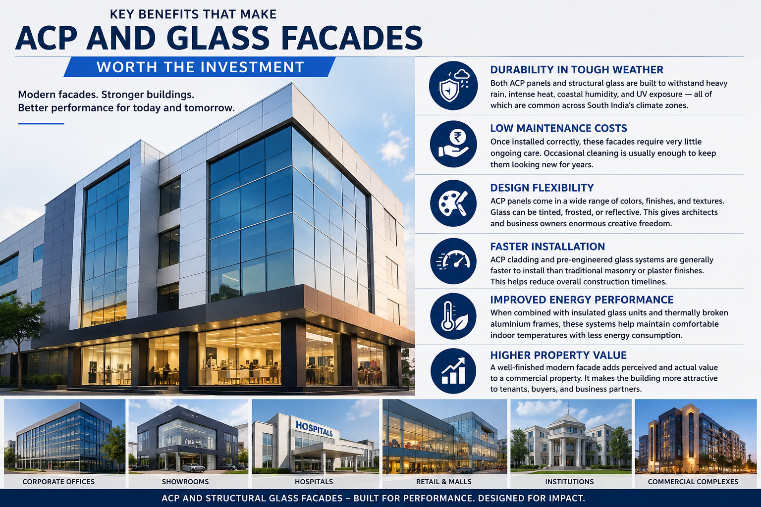
The consistent growth in ACP and structural glass usage across South India comes down to a clear set of practical advantages:
- Weather resistance: Both systems perform reliably across South India’s climate — heat, heavy monsoon rain, coastal humidity, and high UV exposure — without significant degradation over time.
- Low maintenance: Routine cleaning is usually sufficient. There is no need for repainting, replastering, or frequent repairs, which reduces long-term operational costs.
- Design range: ACP offers a wide palette of colors, textures, and finishes. Glass can be tinted, reflective, or frosted — giving projects a customized appearance without complex fabrication.
- Faster project completion: Factory-processed panels and pre-engineered glass systems install faster than traditional finishes, helping developers meet project deadlines.
- Energy performance: Insulated glass units and thermally broken frames reduce heat gain and lower cooling loads, which matters in South India’s warm climate.
- Property value: A clean, modern elevation systems make a commercial property more attractive to tenants, buyers, and occupants, supporting long-term asset value.
Where the Industry Is Heading
For contractors and developers, the future lies in integrated facade solutions — combinations of ACP, structural glazing, curtain wall systems, and advanced aluminium frameworks working together as a single system. Simple Acp cladding in tamilnadu alone is increasingly seen as entry-level; the market is moving toward complete commercial exteriors packages that address aesthetics, structure, and energy performance together.
Sustainability is also becoming a real factor in project specifications. Green-rated buildings and energy-efficient facades are gaining traction not just in Bengaluru and Hyderabad, but gradually across Chennai and Tier-2 cities as well. Global occupiers, in particular, are pushing developers to meet environmental standards — and exterior systems play a significant role in achieving those benchmarks.
As facade systems continue evolving across South India, experienced companies such as Galaxy Graphics & LED are helping commercial projects adopt integrated ACP and structural glazing solutions built for long-term performance and modern architectural requirements.
This article is contributed by Mr.Ahmad Mydeen, an expert in architectural Facade and building elevations. He is the founder of Galaxy Graphics & LED(www.galaxygraphicsled.in), a leading firm specializing in premium ACP facades and structural glazing solutions across Tamil Nadu and South India.