
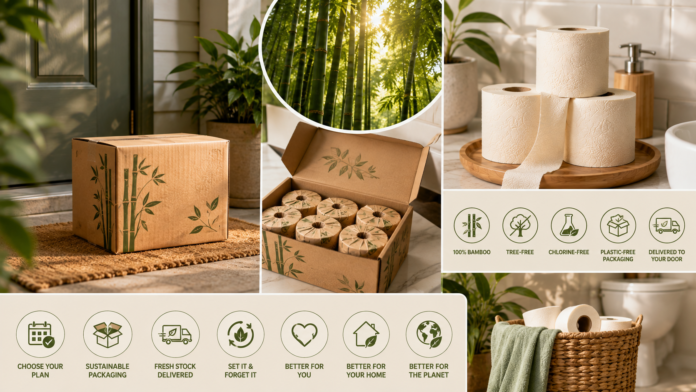


For years, one of the more common complaints about “eco-friendly” toilet paper was simple: it often arrived wrapped in the same plastic film it was supposed to help people avoid. The roll might have been made from sustainably harvested bamboo, but the packaging undercut the pitch before the box was even opened. That criticism has pushed a wave of brands to rethink not just the fiber, but everything around it, and it’s changed what actually shows up on the doorstep with a bamboo bathroom paper subscription today.
The Problem With Plastic Wrap
Plastic film wrap is standard in the toilet paper industry because it’s cheap, protects the product from moisture, and keeps rolls compressed for shipping. But it’s also rarely recyclable through standard curbside programs, which means it typically ends up in the trash regardless of what the roll inside was made from. For a product being marketed on environmental grounds, that packaging gap became hard to ignore.
What’s Changed in the Box
Brands competing in the bamboo bathroom paper space have addressed the issue from a few different angles:
- Individual rolls or bundles wrapped in paper instead of plastic film.
- Shipping boxes designed to be curbside recyclable, without plastic air pillows or foam inserts.
- Compressed rolls that reduce the number of shipments needed, cutting down on both packaging and transportation impact per roll.
The goal across all of these approaches is the same: make sure the sustainability claim holds up from the moment the bamboo is harvested to the moment the box lands on a porch, not just at the fiber stage.
Why This Matters More for Subscriptions Specifically
A one-time purchase of eco-friendly toilet paper is a single packaging decision. A subscription multiplies that decision by every delivery cycle, month after month, for as long as the household stays signed up. That makes packaging choices more consequential for subscription brands than for a single retail purchase, since a plastic-heavy shipment repeated a dozen times a year does more cumulative harm than a one-off buy.
It’s also more visible. A subscription customer physically opens a box every few weeks, which means packaging choices are one of the most direct ways a brand demonstrates it’s serious about sustainability, rather than just making a claim about the paper itself.
What a Plastic-Free Delivery Actually Involves
Companies building their subscription model around this idea, including Wholeroll with its organic bathroom tissue, structure delivery specifically to avoid single-use plastic at every step, pairing a bamboo toilet paper subscription with packaging designed to match the same standard as the product inside. The idea is straightforward: a household switching to bamboo toilet paper shouldn’t have to reconcile a sustainable purchase with a wasteful delivery.
The Trade-Offs Brands Are Managing
Removing plastic isn’t a simple swap, and brands making the change, many of them marketing their product as Organic Bamboo Toilet Paper, have had to solve a few practical problems along the way. Paper wrap offers less moisture protection than plastic film, which matters for a product that needs to stay dry through shipping and storage. It can also be more expensive per unit, a cost that either gets absorbed by the brand or passed along to the subscriber.
Some of the ways companies have worked around these constraints include:
- Using slightly heavier or treated paper stock that holds up better against moisture without resorting to a plastic liner.
- Batching shipments into fewer, larger boxes to reduce the number of times packaging is needed per roll delivered.
- Testing packaging durability specifically for the longer transit times a subscription model requires compared with a same-day store purchase.
These adjustments are part of why plastic-free packaging took longer to catch on industry-wide than the shift to bamboo fiber itself; removing plastic required solving a logistics problem, not just a sourcing one.
What to Look for Before Subscribing
Shoppers evaluating a subscription on packaging grounds specifically are increasingly advised to check a few things before committing:
- Whether the outer shipping box and inner roll wrap are both plastic-free, not just one or the other.
- Whether the packaging materials are actually recyclable in most municipal programs, rather than requiring a specialized drop-off.
- Whether the brand discloses shipment frequency, since fewer, larger deliveries typically produce less packaging waste per roll than frequent small ones.
A Fair Caveat
Packaging alone doesn’t make a subscription sustainable, and reporting from outlets including The Columbian and ABC News has cautioned that overall environmental impact still depends on how the underlying bamboo was farmed and processed, not packaging choices alone. A plastic-free box wrapped around irresponsibly sourced fiber is still an incomplete solution.
The Bottom Line
The shift toward plastic-free delivery reflects a broader maturing of the eco-friendly paper category: the easy part, swapping tree pulp for bamboo, happened first, and the harder part, rethinking everything the product touches on its way to a doorstep, is happening now. For a bamboo bathroom paper subscription to actually deliver on its promise, what’s outside the roll has turned out to matter almost as much as what’s inside it.