
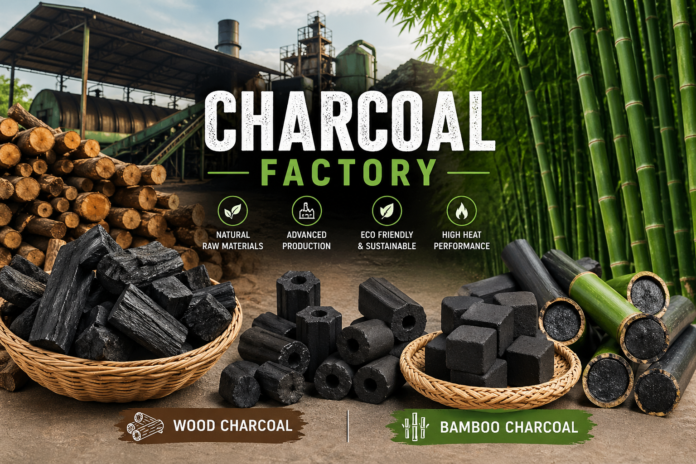


Every serious charcoal buyer eventually faces this question: bamboo or coconut shell? Both are natural, both are premium, both significantly outperform conventional wood charcoal and quick-light alternatives. But they are not the same product, and the differences between them — in burn behaviour, heat profile, flavour interaction, cost structure, and regional market preference — are significant enough to affect your product offering, your customer satisfaction, and your bottom line.
This comparison is written for buyers who need to make an informed commercial decision — shisha lounge owners choosing their house charcoal, restaurant buyers specifying their kitchen fuel, distributors building a product portfolio, and retailers selecting the right product for their private label range. We will go deep on the science, the performance data, and the commercial implications of each choice so you can source with confidence rather than guesswork.
Where Each Charcoal Comes From: Raw Material and Production
Bamboo Charcoal: Moso Bamboo, Controlled Carbonisation
Bamboo charcoal is produced primarily from Moso bamboo (Phyllostachys edulis), harvested at 4–5 years of maturity when lignin content is at its peak. At this stage, the bamboo culm is dense, rigid, and high in the organic compounds that carbonise most efficiently into high-fixed-carbon charcoal.
After harvesting, the bamboo is either ground into powder and extruded into uniform shapes (machine-made bamboo charcoal) or cut into pieces and shaped before carbonisation (shaped bamboo charcoal). Both routes are then carbonised in oxygen-limited kilns at 800°C–1,000°C for standard grades, and up to 1,200°C for high-temperature premium grades.
The primary production regions are Anhui Province and Zhejiang Province in China, along with parts of Vietnam and other Southeast Asian countries. These regions combine the right bamboo species, established production infrastructure, and skilled carbonisation expertise to produce the world’s most consistent bamboo charcoal.
Coconut Shell Charcoal: Agricultural By-Product, Dense Carbon
Coconut shell charcoal is derived from the hard inner shells of mature coconuts — a by-product of the coconut oil, water, and meat processing industries. Because the shell is an agricultural waste material, coconut shell charcoal has a strong sustainability profile: it uses material that would otherwise be discarded and converts it into a high-value fuel product.
Coconut shells are collected from processing facilities in Indonesia, the Philippines, Sri Lanka, and India, then carbonised at similar temperature ranges to bamboo. The natural silica content of coconut shell is higher than bamboo, which contributes to a slightly higher natural ash content and a subtly different combustion chemistry.
Coconut shell charcoal is most commonly produced as small briquettes or cube-cut pieces rather than extruded rod shapes, which affects both packaging efficiency and burn behaviour compared to machine-made bamboo formats.
Side-by-Side Specification Comparison
The table below shows A-Grade specifications for both charcoal types under controlled production conditions. Note that actual batch specifications may vary — always request a Certificate of Analysis from your supplier for the specific batch you are ordering.
| Specification | Bamboo Charcoal (A-Grade) | Coconut Shell Charcoal (A-Grade) |
| Fixed Carbon | 75–82% | 72–78% |
| Ash Content | 3–8% | 5–10% |
| Moisture Max | 6% | 6% |
| Burn Time | 6–8 hours | 5–7 hours |
| Heat Output | Very High & Even | High & Consistent |
| Smoke Level | Very Low | Low |
| Taste Transfer | Neutral / Clean | Slight natural aroma |
| Ignition Time | 8–12 minutes | 10–15 minutes |
| Sustainability | Renewes in 3–5 years | Agricultural by-product |
| Best For | BBQ, Hookah, Restaurant | Hookah, Shisha, BBQ |
| Price Point | Premium–Standard | Premium–Standard |
Buyer’s Note: The specifications above represent A-Grade product from reputable manufacturers with proper quality control processes. Bamboo and coconut shell charcoal from low-quality producers or unverified sources may perform significantly below these figures. Always request documented CoA data — not just a manufacturer’s marketing claims — before committing to a container order.
Burn Performance: What the Specifications Mean in Practice
Heat Output and Temperature Consistency
Bamboo charcoal’s higher fixed carbon content (75–82% A-Grade versus 72–78% for coconut shell) translates directly into higher peak heat output and superior temperature consistency across the grill or hookah bowl. This difference is most noticeable in high-demand applications — a steakhouse running a 200-cover service, or a premium shisha lounge where session temperature consistency is central to the customer experience.
In practical terms, machine-made bamboo charcoal reaches grilling temperature approximately 2–3 minutes faster than coconut shell in equivalent conditions, and maintains that temperature more evenly under continuous cooking load. For restaurant kitchens where service timing is non-negotiable, this margin matters.
Coconut shell charcoal produces excellent, consistent heat in its own right — the difference versus bamboo is in the upper range of performance, not in basic function. For hookah and shisha applications where the heat management is handled by the foil and the session pace is more relaxed, coconut shell performs extremely well and is the preferred choice in several high-volume markets.
Ash Production
Bamboo charcoal at A-Grade typically produces 3–8% ash by weight, compared to 5–10% for coconut shell at equivalent grade. In absolute terms, both are low-ash products that comfortably outperform wood charcoal (15–25%) or quick-light charcoal (20–30%). But for premium hookah lounges where ≤3% ash is the target specification for A-Grade, bamboo’s lower natural silica content gives it a structural advantage.
For bulk charcoal for restaurants sourcing decisions, the ash difference between bamboo and coconut shell at A-Grade is operationally negligible in most kitchen applications. Both require grill management at similar intervals and both produce far less maintenance burden than the wood or quick-light charcoal they are replacing.
Smoke, Odour, and Flavour Transfer
Both bamboo and coconut shell natural charcoal produce very low smoke and minimal odour when properly carbonised — especially compared to quick-light alternatives. However, there is a subtle difference: coconut shell charcoal has a faint natural aroma during ignition and early combustion that some users describe as slightly sweet or tropical. This aroma largely dissipates by the time the charcoal reaches full temperature and is imperceptible during actual shisha or cooking use.
Bamboo charcoal is completely neutral in aroma and flavour transfer at operating temperature. For precision-cooking applications — yakitori, robata, wagyu beef grilling — where the flavour profile of the charcoal is the baseline and any contamination is unacceptable, bamboo’s complete neutrality is a meaningful advantage.
Which Is Better for Hookah and Shisha?
The hookah and shisha market has strong regional preferences that have as much to do with tradition and availability as with measurable performance differences:
• Middle East and Gulf States: Historically a strong coconut shell market. Saudi Arabia, UAE, Kuwait, and Bahrain have established import relationships with Indonesian and Sri Lankan coconut shell producers, and many premium lounge operators in these markets have built their product standards around coconut shell charcoal’s specific combustion profile.
• Europe (Netherlands, Germany, UK): Mixed market with strong bamboo charcoal penetration, particularly in premium lounges. The consistency of machine-made bamboo in cube format has driven significant adoption in the European hookah bar scene over the past decade.
• Southeast Asia: Strong bamboo preference, closely linked to proximity to bamboo production regions in China and Vietnam.
• North America: Emerging market with limited established preference. New lounge operators are making decisions based on availability, documentation quality, and price rather than tradition.
For buyers sourcing wholesale hookah charcoal for a specific regional market, the honest recommendation is to source the product type your target market already uses — and to source it at A-Grade directly from a manufacturer who can provide a Certificate of Analysis. The performance difference between A-Grade bamboo and A-Grade coconut shell is smaller than the performance difference between either of those products and a B-Grade or low-quality version of the other.
Hookah Verdict: Both materials perform excellently at A-Grade. Regional market preference is the primary deciding factor for commercial buyers. If your target market has an established preference — respect it and source it well. If you are entering a new market without established preference, bamboo’s superior consistency and availability make it the lower-risk starting choice.
Which Is Better for BBQ and Grilling?
For wholesale BBQ charcoal applications, bamboo charcoal’s machine-made consistency gives it a clear operational advantage in professional settings. The extrusion process that produces hexagonal and square rod bamboo charcoal creates pieces of exactly uniform density, weight, and dimension. This uniformity means predictable ignition time, predictable heat build, and predictable burn duration — characteristics that are commercially critical for restaurant kitchens and operationally valuable for serious home grillers.
Coconut shell charcoal for BBQ applications is less common because coconut shell naturally produces smaller, less uniform pieces that are harder to pack efficiently in retail bags and less predictable in high-volume kitchen environments. It remains strong in specific barbecue traditions where piece size and shape are less critical to the cooking method.
For retailers developing a private label charcoal for supermarkets range targeting the BBQ grilling consumer, machine-made bamboo in hexagonal or pillow briquette format is the default recommendation. The visual uniformity, the on-pack sustainability story, and the burn performance data all support a premium positioning that coconut shell cannot match as cleanly in a retail context.
BBQ Verdict: Bamboo charcoal is the stronger commercial choice for retail BBQ, restaurant grilling, and precision cooking applications. Its machine-made consistency, neutral flavour profile, and superior heat output make it the professional standard for live-fire cooking globally.
Sustainability: Both Have a Genuine Eco Credential
One of the questions buyers increasingly ask is which charcoal type has the stronger environmental profile. The answer is that both bamboo and coconut shell charcoal have genuine and defensible sustainability credentials — but for different reasons.
Bamboo Sustainability
Bamboo is one of the fastest-growing plants on earth. Moso bamboo reaches harvestable maturity in 3–5 years, compared to 20–50 years for hardwood trees. It self-regenerates after harvesting without replanting. The bamboo forests that supply charcoal production sequest carbon during growth, stabilise soil, and support local agricultural communities. For retailers and brands making environmental claims on packaging, bamboo charcoal has an exceptionally clean story.
Coconut Shell Sustainability
Coconut shell charcoal is produced from agricultural waste — the shells discarded after coconut processing. No additional land use, no additional farming, no deforestation. It converts a waste stream into a high-value product. From a circular economy perspective, this is an excellent sustainability narrative, particularly for brands positioned around waste reduction and circular production principles.
The Commercial Decision: How to Choose for Your Business
For most commercial buyers, the decision between bamboo and coconut shell charcoal ultimately comes down to four factors:
• Your target market’s existing preference — respect established purchasing habits in your channel before trying to educate them on alternatives.
• Your application’s performance requirements — A-Grade bamboo for precision cooking and premium hookah; coconut shell where regional market preference is established.
• Your supplier’s capability — the best charcoal for your business is the one your chosen charcoal distributor and supplier can supply consistently, with proper documentation, at a price point that makes your margin work.
• Your brand’s sustainability narrative — both materials support an eco-story, but bamboo’s renewable farming narrative tends to be easier to communicate to Western retail consumers unfamiliar with coconut agricultural by-product chains.
For distributors building a full charcoal product portfolio — covering hookah, BBQ, restaurant, and retail categories — sourcing both bamboo and coconut shell products from the same manufacturing partner simplifies your supply chain, allows you to serve market-specific preferences without adding supplier relationships, and positions you as a genuinely knowledgeable supplier rather than a one-product vendor.
Final Thoughts: Grade Matters More Than Material
Here is the most important insight from this entire comparison: the difference between A-Grade bamboo and A-Grade coconut shell charcoal is far smaller than the difference between A-Grade and B-Grade of either material. A business sourcing B-Grade coconut shell because it is cheaper than A-Grade bamboo has made the wrong trade-off. The quality gap between grades is what your customers experience — the material choice is largely invisible to them.
Source the right grade for your application. Source it directly from a manufacturer you have vetted properly, with documented specifications per batch. And let the material choice be informed by your market’s preferences and your own testing — not by marketing claims from suppliers who have a commercial reason to push one product over another.
Get samples of A-Grade bamboo and coconut shell charcoal from a direct manufacturer: thecharcoalfactory.com/wholesale-hookah-charcoal