
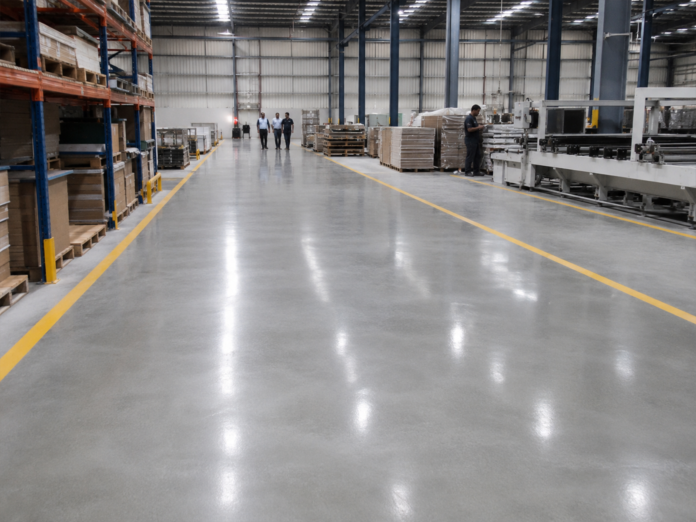


An interior designer working on a high-end residential project in one of the city’s newer luxury enclaves recently found herself in an unusual conversation with a client who had, until that point, assumed the flooring decision was really a choice between imported marble and engineered timber. Midway through the design presentation, the designer suggested polished concrete instead, for the main living areas of a home that had already committed a serious budget to premium finishes elsewhere.
The client’s first reaction was mild disbelief. Concrete, to most people, still conjures a parking garage or a factory floor, not the kind of surface anyone would deliberately choose for a home built to signal exactly the opposite. That reaction has become less common than it used to be, and the reasons behind the shift say something real about how luxury design is evolving.
From Hidden Substrate to Deliberate Finish
For most of the last century, concrete’s only role in a premium interior was structural, poured to support whatever finish would eventually cover it. Nobody looked at it, let alone chose it on purpose. That began changing as diamond grinding and polishing technology matured enough to reliably take a raw slab to a genuinely refined, reflective finish, and as staining and decorative techniques expanded what that finish could actually look like.
Once concrete could be finished this well, designers working in minimalist and contemporary styles started treating it as a legitimate material choice rather than a budget compromise, valued specifically for the honest, monolithic quality that a seamless polished floor brings to a space that marble or tile, with their visible joints and repeating patterns, simply can’t replicate.
What Luxury Design Actually Values Here
Part of what’s driving this shift is aesthetic, but not all of it. Polished concrete offers something genuinely difficult to achieve with other premium materials: a continuous, uninterrupted surface that reads as calm and expansive in a way that a jointed material never quite manages, no matter how expensive the tile. In large open-plan luxury homes specifically, that visual continuity has become a real design objective in its own right.
The shift from a purely utilitarian material to a genuinely premium surface reflects advances in finishing technique as much as changing taste. Gloss level, color, and texture can all now be controlled precisely enough that two polished concrete floors in different homes can look almost nothing alike, which has quietly undercut the old assumption that concrete flooring means one uniform, industrial look.
Decorative Technique Expanded What’s Actually Possible
Staining, in particular, changed the conversation considerably. Acid-based stains produce organic, variegated color that has genuine visual depth, closer to natural stone in character than most people expect from concrete, while saw-cut patterns and exposed aggregate finishes add further range without introducing a second material into the space at all. Decorative concrete techniques have matured to the point where a design team can specify a very specific look, warm or cool, textured or smooth, and achieve it reliably, rather than settling for whatever a plain grey pour happened to produce.
The Practical Case Sits Quietly Underneath the Aesthetic One
None of this would matter as much if concrete performed poorly once it looked good, but the opposite is generally true. A properly finished and sealed polished concrete floor is genuinely durable, resists staining reasonably well, and, when paired with radiant floor heating, avoids the cold-underfoot reputation concrete has carried for decades. For clients weighing long-term maintenance alongside upfront appearance, that combination has become a meaningful part of the pitch, not just an afterthought once the aesthetic decision is already made.
Why This Client Said Yes
The designer’s client eventually agreed to the polished concrete, though only after seeing a sample finished in the specific warm grey tone proposed for the home, paired with a mockup of how it would read under the home’s planned lighting. What convinced the client wasn’t a cost argument. It was seeing that concrete, finished properly, genuinely looked like the premium material it was being proposed as, rather than a compromise dressed up as one.
That’s really the story behind concrete’s move into luxury design more broadly. Nobody is choosing it because it’s cheap, even though it often is. They’re choosing it because, for the first time in the material’s long history, it can actually deliver the specific look a luxury project is asking for, on its own terms, without needing to imitate anything else.
About Floorzy
Floorzy is a concrete floor transformation company focused on improving the performance, durability, aesthetics, and longevity of existing concrete floors. The company develops customized floor transformation systems for factories, warehouses, schools, hospitals, parking structures, commercial buildings, and industrial facilities, and publishes ongoing research through the Floorzy Concrete Knowledge Library.